
Physics-based simulation for
heating, cooling and anergy networks
IDA Districts simulates buildings, heating, cooling and anergy networks, energy sources, storage and control strategies as one integrated energy system. The simulation is dynamic, physics-based and also covers complex ring, multi-source, bidirectional and meshed networks.
Planning certainty starts with simulation.
This delivers reliable decision support for planning, sizing, operation and transformation of thermal district and energy systems.
The challenge
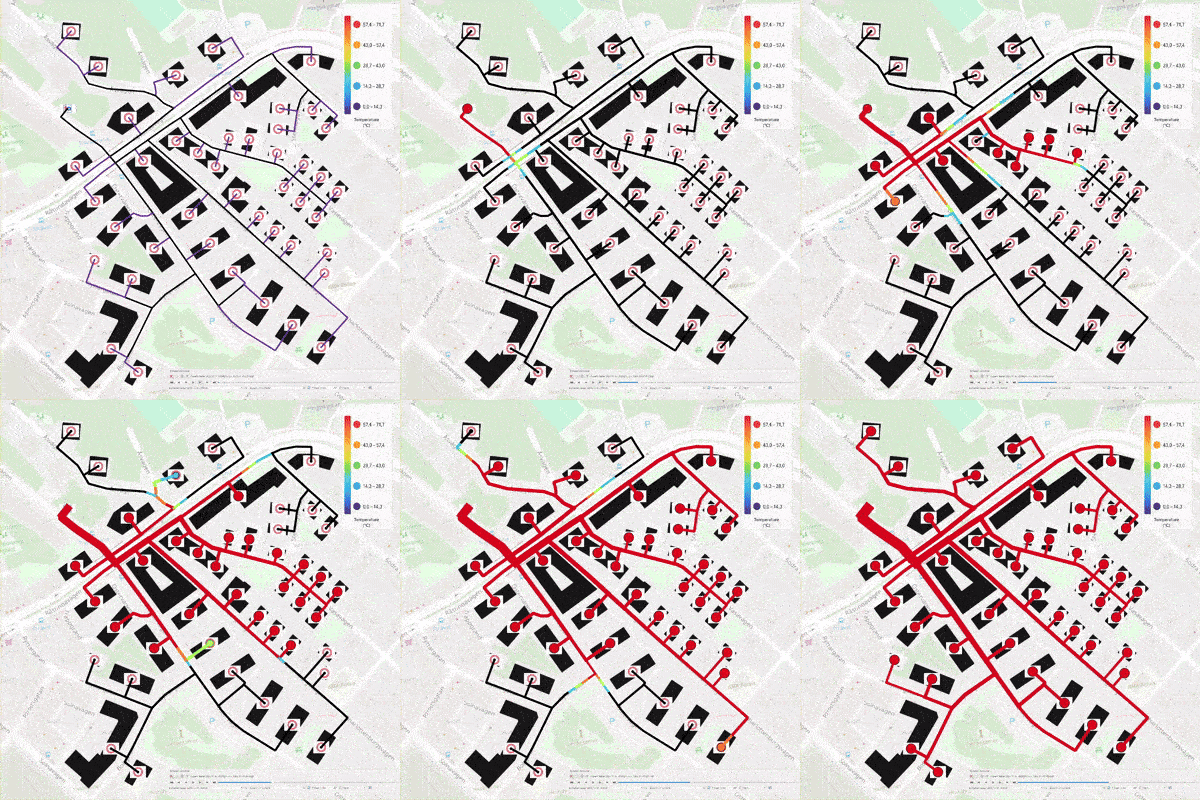
Thermal networks are becoming more and more complex
Planners, utilities and operators face many questions at once, and static calculations are no longer enough.
- Which network temperatures make sense in the long term, also for cooling and anergy concepts?
- How do ring, multi-source and meshed networks behave under changing flow directions?
- What role do heat pumps, seasonal storage and prosumers play?
- How do control strategies and operating modes affect stability and losses?
- Which investments are truly viable, including extension and transformation scenarios?
The solution
Simulation instead of assumptions
IDA Districts models thermal district and energy systems dynamically and physics-based, combining buildings, network hydraulics, energy sources, storage and control strategies.
- Test, compare and validate technical concepts before implementation
- Realistically assess flow directions, bottlenecks and critical operating states
- Reliable basis for investment, operation and transformation decisions
What makes IDA Districts unique
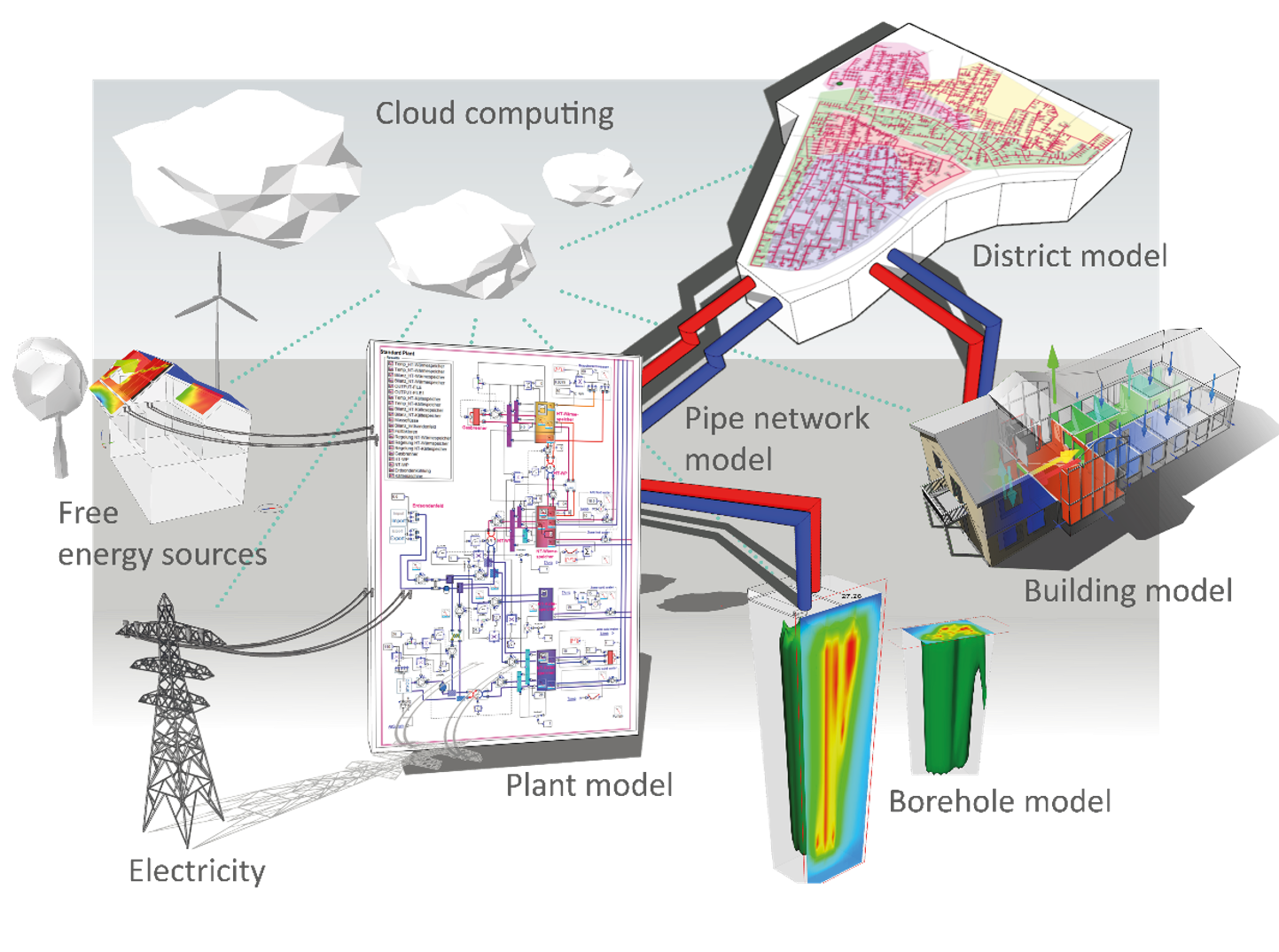
Holistic simulation of buildings, networks and plants
Most tools look at either buildings or networks. IDA Districts combines both in one physics-based integrated model for heating, cooling and anergy systems.
How do buildings respond to network temperatures?
Dynamic feedback between building load and network operation, including storage effects.
How do loads affect hydraulics?
Pressure, mass flow and temperature are calculated in a coupled, time-dependent way.
How do control strategies affect network stability?
PI controllers, thresholds and prioritisation logic, all in one simulation run.
How do network losses evolve over time?
Physics-based pipe models with soil coupling, insulation and real burial profiles.
Capabilities
A powerful simulation platform for thermal energy systems
Dynamic, physics-based system simulation
Simulation of the entire thermal energy system, with coupled buildings, networks, sources, storage and controls over time.
Hydraulics, network design and sizing
Dynamic thermo-hydraulic pipe network simulation, analysis of pressure, mass flows and critical network points, including multi-pipe systems such as 4-pipe networks.
Complex network topologies
Radial, tree, ring and meshed networks, multi-source and bidirectional systems, analysis of changing flow directions and critical operating states.
Flexible network concepts and modelling
Heating, cooling, LowEx and anergy networks, cold local heating and bidirectional systems, flexible modelling of sources, storage and consumers.
Analysis, control and optimisation
Simulation of complex control strategies, variant and scenario analyses, evaluation of efficiency, network losses and temperature concepts.
GIS integration via QGIS
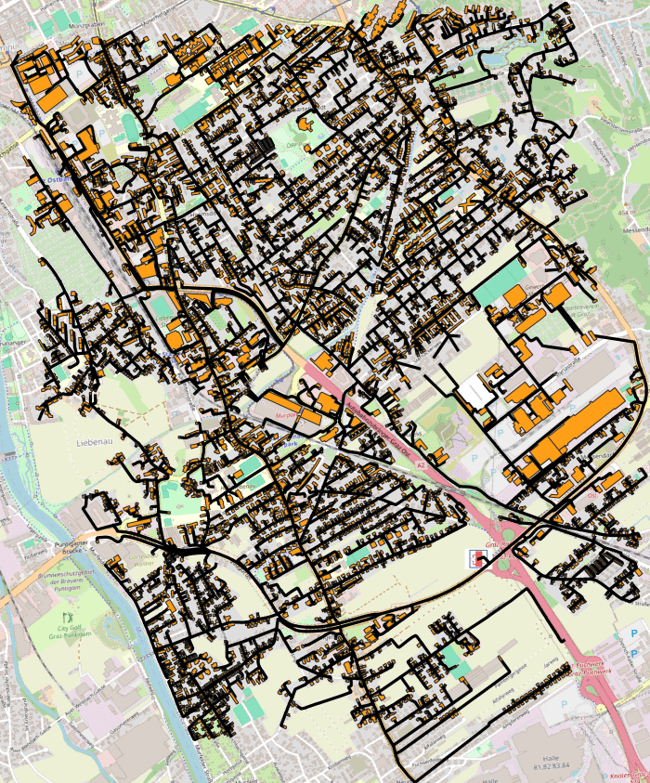
Generate districts and network topologies directly from geospatial data, with a consistent data flow between the GIS world and dynamic simulation.
Supported network concepts
From classical sizing to bidirectional anergy networks
IDA Districts covers both classical and modern thermal network concepts, whether you are sizing new structures or transforming existing legacy networks.
Radial and tree networks
Classical network planning and sizing.
Ring networks
Assessment of redundancy and security of supply.
Meshed networks
Complex hydraulics and changing flow directions.
Multi-source networks
Optimisation of multiple generators, storage and feed-in points.
Cold local heating networks
Coupling of sources, buildings and heat pumps.
Bidirectional networks
Modelling of prosumers, waste heat and reverse feed-in.
Legacy networks
Analysis of bottlenecks, extension and transformation.
Multi-pipe systems
For example, 4-pipe networks for combined heating and cooling supply.
Inside the product
From geospatial data to a print-ready report
IDA Districts fits into your planning workflow, from GIS-based network creation through physics-based simulation to automated reporting.
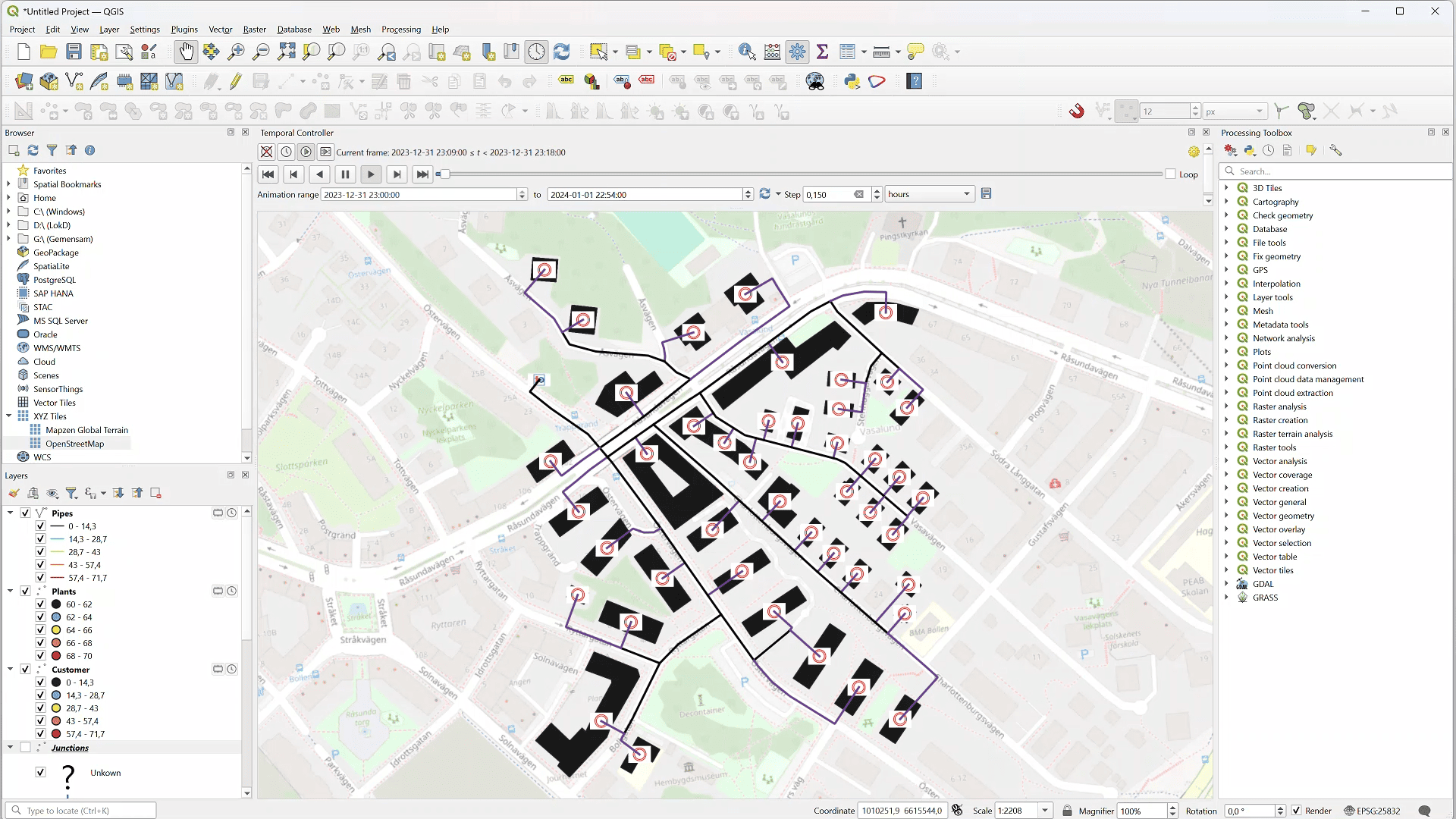
QGIS Integration
Build networks directly from geospatial data
The QGIS plugin connects IDA Districts to your GIS world. Buildings, pipe routes, connections and consumers are taken directly from geospatial data, delivering entire districts in just a few minutes.
- Import building footprints and pipe routes directly
- Automatic generation of network topology
- Consistent data flow between GIS and simulation
Simulation environment
Model, simulate, understand
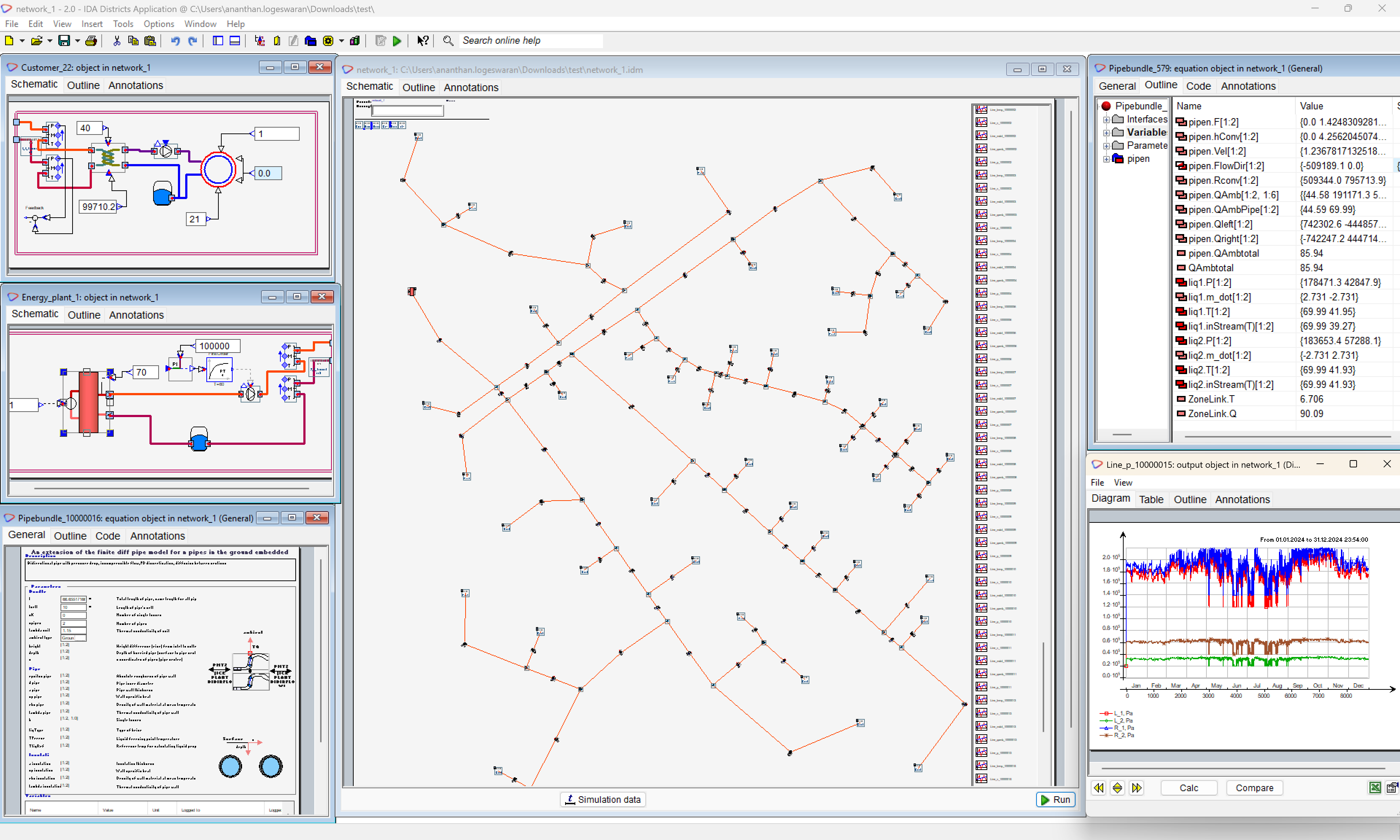
The IDA Districts interface brings together network topology, component models and dynamic results in a single environment. Control strategies, pipe bundles and sources are modelled as linked objects, with direct access to every variable.
- Object-oriented modelling of buildings, sources, storage and controls
- Dynamic profiles of temperature, pressure and mass flow in real-time plots
- Modelica translator for custom and research component models
Reporting and KPIs
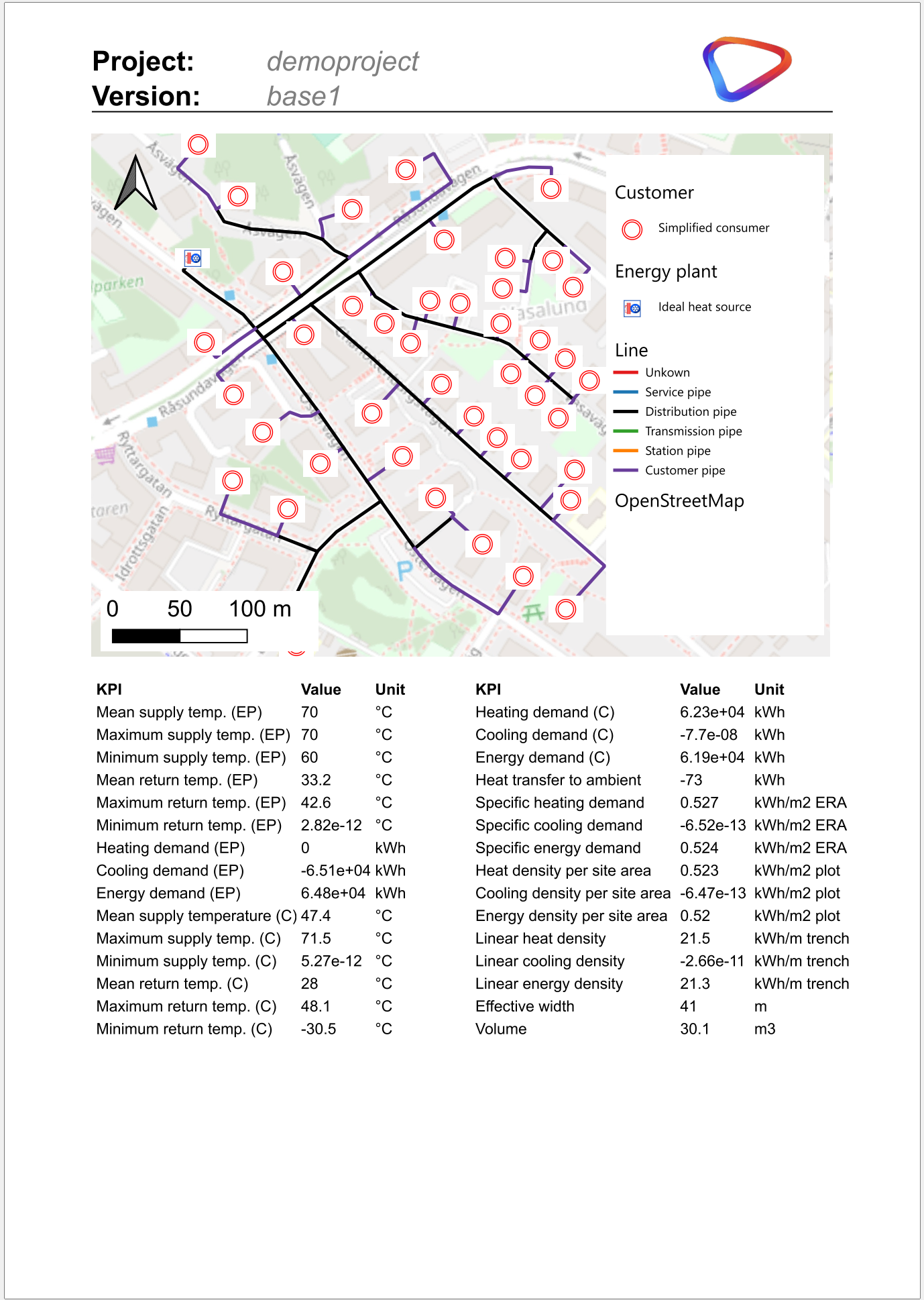
Reliable KPIs, from worst point to energy density
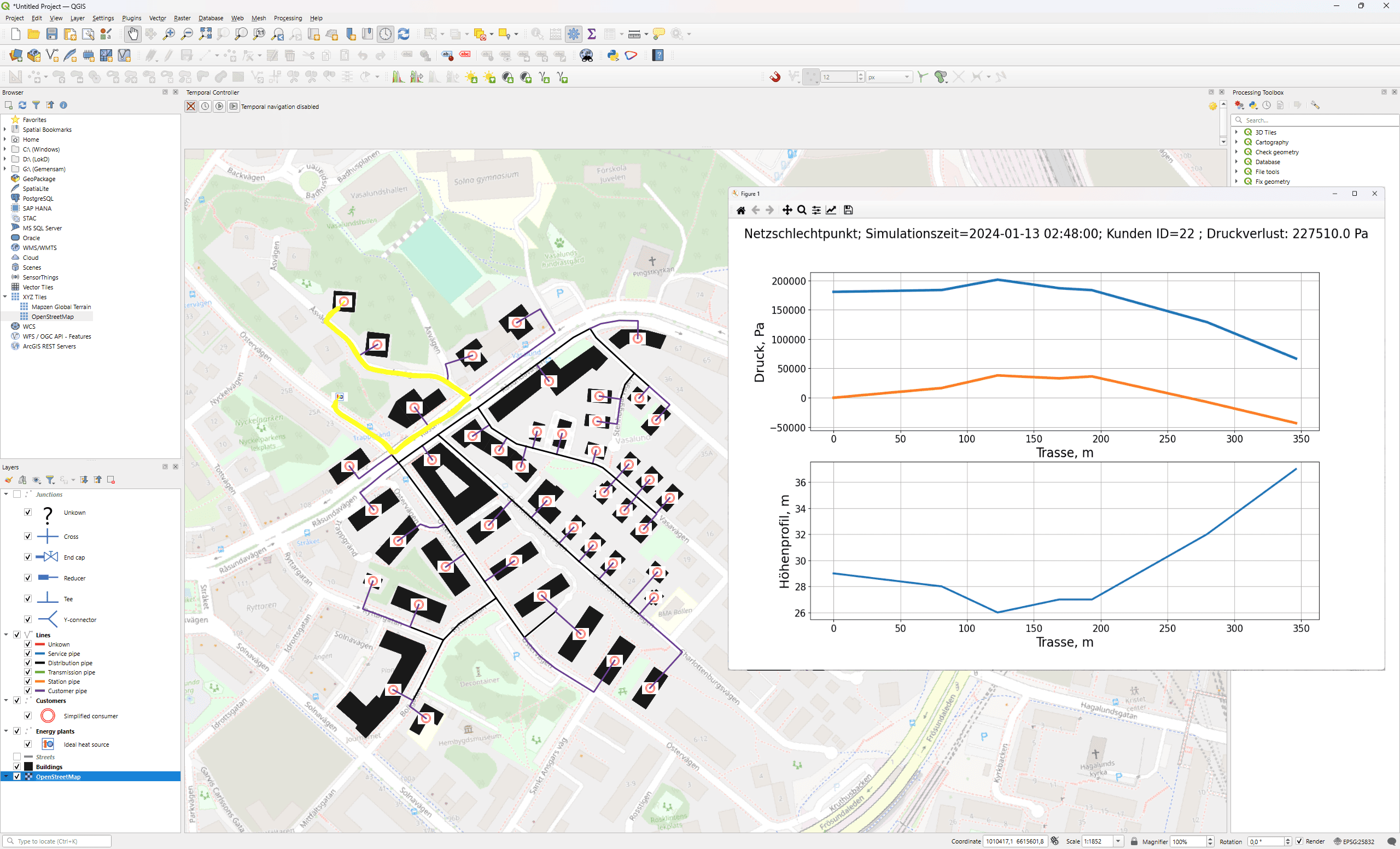
IDA Districts automatically generates print-ready reports with network maps, KPIs and analyses. The hydraulic worst point can be visualised directly from the simulation, including pressure and elevation profiles along the critical route.
- Worst-point analysis with pressure and elevation profile
- Heat demand, energy density, linear density and network losses as KPIs
- Direct comparability between variants and transformation scenarios
Typical use cases
Where IDA Districts is used
Planning, sizing and system understanding
Sizing of pipes, pumps and generators, analysis of load flows and temperature distribution, investigation of complex ring, multi-source and meshed networks.
Operation, economics and optimisation
Optimisation of operating strategies, reduction of energy losses, evaluation of supply, return and network temperatures, economic comparison of operating modes.
Transformation, extension and integration
Integration of renewable energy and waste heat, incorporation of seasonal heat storage, transformation to LowEx, anergy or bidirectional networks.
Resilience, security and operating scenarios
Simulation of pipe rupture, pump or generator failure, analysis of redundancies and security of supply, evaluation of alternative supply paths.
Climate protection, regulation and innovation
Verification of CO₂ savings, comparison of decarbonisation pathways, evaluation of climate-friendly heating, cooling and anergy concepts, virtual test bench for research, control and education.
Audience and benefits
Who IDA Districts is built for
IDA Districts supports planners, utilities, operators and investors in designing thermal district and energy systems that are efficient, resilient and climate-friendly.
Consulting engineers and planning offices
MEP · energy consulting · planning
Greater planning certainty
Realistic simulation reduces uncertainty.
Fewer planning errors
Bottlenecks, oversizing and hydraulic issues are identified early.
Complex networks made manageable
Ring, multi-source and meshed networks become transparent and assessable.
Stronger basis for decisions
Simulation results support decisions and communication.
Utilities and operators
Municipal utilities · network operators · heat supply
Optimised network operation
Generators, storage, consumers and the network are better coordinated.
Reduced operating costs
Losses and inefficient operating modes can be reduced systematically.
Robust transformation strategies
Decarbonisation and renewables become realistically assessable.
Higher security of supply
Redundancies, outages and alternative supply paths become simulatable.
Developers and investors
Project developers · municipalities · city planners
Well-founded investment decisions
Economic viability, risks and system performance become assessable early.
More transparency
Simulation shows how the system is likely to perform in operation.
Fewer wrong decisions
Concepts are tested and compared before implementation.
Proof of sustainability
CO₂ savings and efficiency potentials become quantifiable.
Trust
Built by EQUA
For more than 30 years, EQUA has been a pioneer in physics-based simulation of buildings and energy systems. With solutions like IDA ICE, we support engineers worldwide. With IDA Districts, we extend this expertise to thermal district and energy systems.
30+
years of simulation expertise
30+
countries in use
5.000+
engineers worldwide
Get started
Plan thermal networks with simulation
Test concepts virtually before you build them. Make informed decisions for climate-friendly and cost-efficient heating, cooling and anergy systems.